
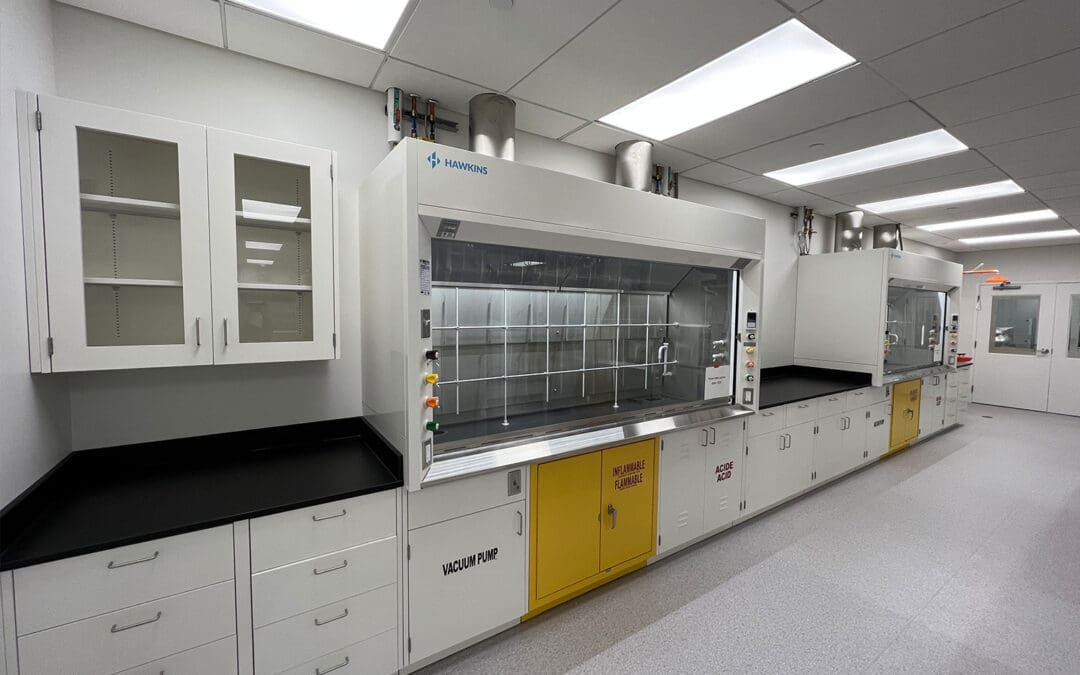
Choosing the right chemical fume hood is one of the most critical decisions in any laboratory project. Fume hoods are not standalone products. They are integral safety systems that influence airflow design, energy performance, workflow efficiency, and long-term operational costs.
As laboratories across Canada continue to evolve in 2026, fume hood selection has become less about picking a standard unit and more about designing the right system for the space, the users, and the future of the facility.
Start with the Project, Not the Product
The most effective fume hood solutions begin with understanding how the laboratory will operate. End users, architects, and contractors all play a role in defining requirements, but the key questions remain consistent.
How will the lab be used day to day? Will it support teaching, advanced research, or clinical workflows? Are large instruments or complex setups required? Is adaptability important as research priorities shift?
Answering these questions early allows the fume hood system to be properly integrated into the overall laboratory casework solution, rather than treated as an isolated component.
Floor-Mounted Fume Hoods for Complex Research Environments
For laboratories that require large equipment or complex experimental setups, floor-mounted fume hoods are often the right choice. These systems are designed to accommodate tall or oversized apparatus while providing the access, containment, and safety performance required in high-demand research environments.
Floor-mounted fume hood systems are commonly specified in advanced research facilities where flexibility, safety, and long-term performance are critical. Their availability in both Constant Air Volume and Variable Air Volume configurations allows them to integrate with a wide range of HVAC strategies across research environments.
Teaching Fume Hoods for Educational Facilities
Teaching laboratories present a different set of priorities. Visibility, safety, and engagement are critical, particularly in college and university settings.
Teaching fume hoods are designed to support instructor demonstrations while allowing students clear sightlines from multiple angles. Glass side panels and backs improve visibility, while flexible layout options allow hoods to be installed side by side or back to back. These systems integrate seamlessly with both Constant Air Volume and Variable Air Volume HVAC systems, making them well suited for modern educational facilities across Canada.
Bench-Mounted and Specialized Fume Hoods
Bench-mounted fume hoods are the most widely used fume hoods in laboratory environments and serve as the foundation of many lab designs. They are commonly specified for day-to-day chemical handling and experimental work, offering reliable containment, consistent airflow, and efficient use of laboratory space.
Within bench-mounted systems, there is also a wide range of specialty fume hoods designed to support specific applications and hazards. These include perchloric acid fume hoods, radioisotope hoods, accessible configurations, and pass-through designs. Each specialty hood addresses unique safety, material, and ventilation requirements, making proper selection critical during the planning phase.
Energy Performance and Air Volume Strategy
One of the most important considerations in fume hood selection is the choice between Constant Air Volume and Variable Air Volume systems.
Constant Air Volume systems provide consistent airflow and are often used in simpler or legacy laboratory designs. Variable Air Volume systems adjust airflow based on sash position and occupancy, significantly reducing energy consumption. With sustainability and energy efficiency becoming key considerations across Canada, Variable Air Volume fume hoods are becoming the preferred option for many new laboratory projects.
Why System Integration Matters
A fume hood does not operate in a vacuum. Its performance is directly tied to laboratory casework, adaptable table systems, work surfaces, and ventilation design. When these elements are coordinated early, the result is a safer, more efficient, and more flexible laboratory environment.
Alliance Scientific works closely with project teams to support full laboratory casework solutions, including fume hoods, adaptable furniture systems, and integrated planning. With local expertise across Canada, Alliance Scientific helps clients navigate complex projects, vet requirements early, and focus on solutions that deliver long-term value rather than short-term fixes.
Supplying Trusted Fume Hood Solutions
Alliance Scientific supplies a comprehensive range of chemical fume hoods from both Bedcolab and H.H. Hawkins. This includes floor-mounted, teaching, bench-mounted, and specialty fume hood solutions designed to meet the needs of research, educational, healthcare, and industrial laboratory environments across Canada.
Final Thoughts
There is no single fume hood that fits every laboratory. The right solution depends on the project, the people using the space, and the demands placed on the facility over time.
By approaching fume hood selection as part of a broader laboratory infrastructure strategy, organizations can build labs that are safer, more adaptable, and ready for the future.