University laboratory design has evolved significantly in recent years. Teaching environments are no longer built around isolated benches and static demonstration areas. Today’s higher education labs must support visibility, engagement, collaboration, and safety, all within increasingly complex mechanical and energy frameworks.
At the center of this shift is the Vision Teaching Hood. In modern university settings, it is not simply a containment device. It is a communication tool.
Why Visibility Matters in Teaching Labs
Instructors need to demonstrate techniques clearly. Students need unobstructed sightlines to observe reactions, measurements, and procedural details. Traditional chemical fume hoods were engineered primarily for containment performance. In a teaching lab, containment alone is not enough.
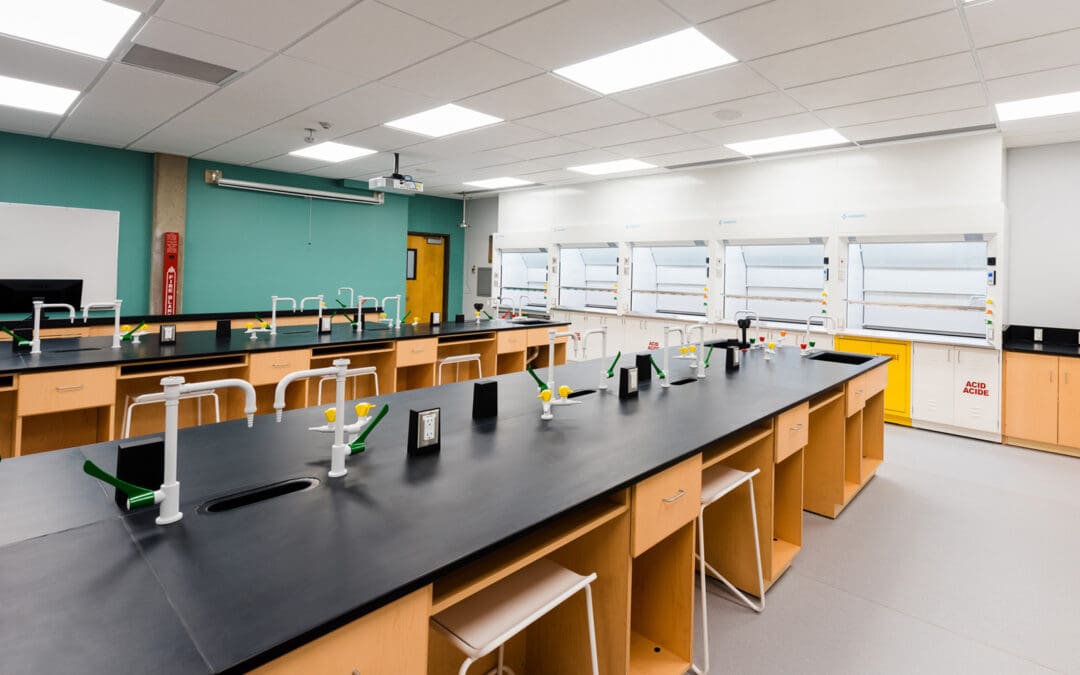
Vision Teaching Hoods are designed specifically for college and university environments where demonstration and observation are equally important. With interior glass side panels and glass backs integrated alongside vertical rising sashes, these hoods create multiple sightlines. Students positioned at different angles can observe procedures safely without crowding the front opening.
This design directly supports collaborative learning. Instead of gathering around a single viewing angle, students remain distributed throughout the lab while maintaining visual access to the instructor’s work.
Configurations That Support Collaboration
Collaborative university labs require flexible layout strategies. Vision Teaching Hoods can be installed in side by side arrangements or back to back configurations, making them well suited for both perimeter and central island layouts.
Instructors can conduct demonstrations from a central location while students work in adjacent stations, maintaining visibility across the room. In larger teaching environments, multiple hoods can be arranged to create consistent demonstration zones without disrupting circulation paths.
Because these hoods are compatible with both Constant Air Volume and Variable Air Volume HVAC systems, institutions can integrate them into existing mechanical strategies or specify energy conscious airflow systems in new builds. In large academic facilities with multiple hoods operating simultaneously, this flexibility becomes a critical planning consideration.
Safety and Airflow Performance in Education Settings
Visibility cannot compromise safety. Vision Teaching Hoods incorporate integrated rear lower and side post baffle arrangements to manage airflow effectively within the enclosure. Proper airflow control is especially important in a teaching environment where sash positions may change frequently during demonstrations.
Compatibility with both CAV and VAV systems allows universities to balance containment requirements with operational efficiency. Variable Air Volume configurations can reduce airflow when sashes are lowered, supporting energy performance goals without sacrificing safety standards.
For university institutions planning capital projects across the GTA, Ottawa, or Western Canada, this mechanical flexibility allows Vision Teaching Hoods to integrate smoothly into broader building performance strategies.
Designing the Lab Around the Hood
In collaborative university labs, the placement of the teaching hood influences the entire room layout. Sightlines, circulation, workstation spacing, and service distribution must all be coordinated during the planning phase.
When Vision Teaching Hoods are positioned intentionally, they become anchors within the space. Demonstration areas remain clearly defined, yet connected to surrounding student work zones. The result is a lab that supports both instruction and interaction rather than isolating one from the other.
In many projects, this coordination also involves integration with adaptable furniture systems and service infrastructure. When these systems are planned alongside Vision Teaching Hoods, institutions gain the flexibility to reconfigure collaborative layouts as programs evolve.
Planning With the Right Partner
Designing effective teaching laboratories requires more than selecting equipment. It requires early collaboration between architects, engineers, academic stakeholders, and laboratory specialists.
Alliance Scientific supports institutions through laboratory planning and coordinated project execution. Design Support and Design Build Services can play a role in ensuring that Vision Teaching Hoods, mechanical systems, and room layouts are aligned from the earliest design stages.
Installation quality is equally important in academic environments where durability and performance expectations are high. Early engagement with experienced installation teams can help ensure that teaching hoods are assembled and integrated correctly within the overall lab infrastructure.
Final Thoughts
Vision Teaching Hoods are built for education. Their multi-sightline visibility, flexible configurations, and HVAC compatibility make them uniquely suited for collaborative university labs where visibility and safety must work together.
When specified thoughtfully and integrated into a coordinated laboratory design strategy, these hoods do more than contain fumes. They support instruction, encourage engagement, and help institutions create learning environments that are technically sound and academically effective.