
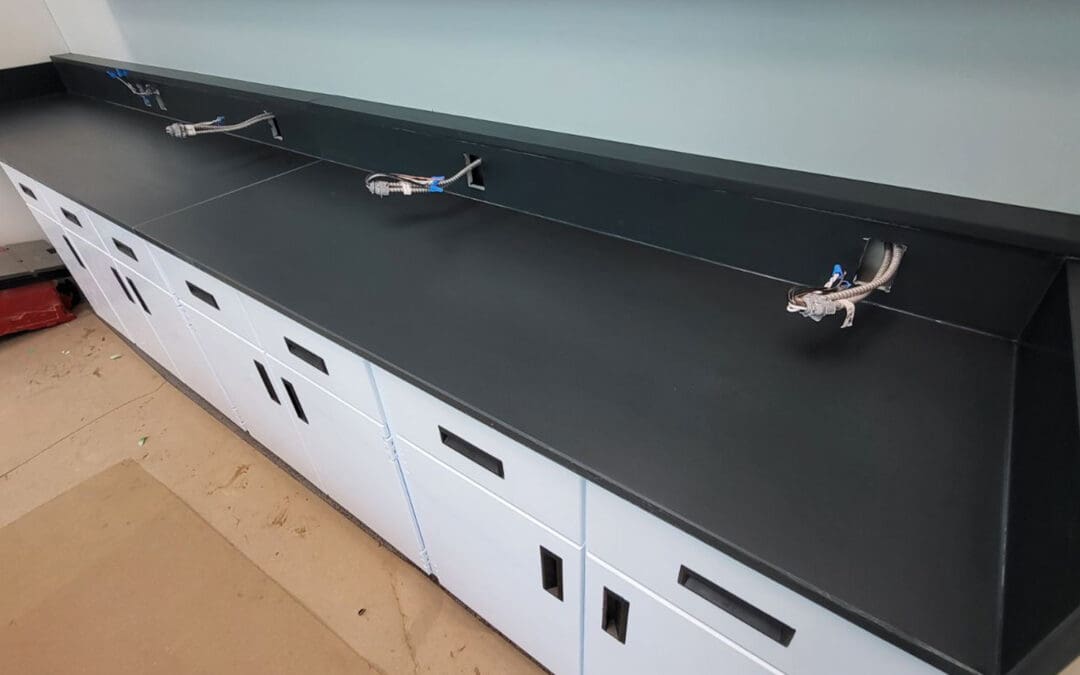
When planning a new laboratory or upgrading an existing facility, work surfaces play a much larger role than many people realize. Laboratory countertops are exposed to harsh chemicals, heat, impact, moisture, and constant daily use. Choosing the wrong material can lead to premature wear, contamination concerns, and costly replacements.
That is why epoxy resin countertops continue to be one of the most trusted choices in laboratory environments across Canada.
From pharmaceutical facilities and research labs to educational science classrooms and healthcare environments, epoxy resin work surfaces are widely recognized for their durability, chemical resistance, and long-term performance.
What Are Epoxy Resin Countertops?
Epoxy resin countertops are solid, non-porous laboratory work surfaces specifically engineered for demanding scientific environments. Unlike laminate or surface-coated materials, epoxy resin is monolithic, meaning the chemical and heat resistance exists throughout the entire core of the product rather than only on the surface.
This construction allows epoxy resin countertops to maintain their integrity even after years of exposure to aggressive laboratory conditions.
Because the material is solid throughout, scratches or surface wear do not compromise performance. This makes epoxy resin an ideal solution for laboratories where durability and reliability are critical.
Why Laboratories Choose Epoxy Resin Work Surfaces
Laboratories require materials that can consistently perform under pressure. Epoxy resin countertops are designed specifically for these conditions and offer several advantages that make them a preferred option for laboratory casework systems.
Exceptional Chemical Resistance
One of the biggest reasons laboratories choose epoxy resin countertops is their ability to withstand exposure to harsh chemicals. Acids, solvents, and corrosive substances can quickly damage standard surfaces, but epoxy resin is engineered to resist chemical attack while maintaining a safe and stable work environment.
This makes epoxy resin especially valuable in:
- Pharmaceutical laboratories
- Chemical research facilities
- Clinical and diagnostic labs
- University science departments
- Analytical testing environments
For laboratories handling aggressive compounds daily, chemical resistance is not simply a convenience. It is essential for both safety and longevity.
High Heat Resistance
Laboratory work often involves hot equipment, open flames, and elevated temperatures. Epoxy resin countertops provide strong heat resistance and are designed to withstand demanding thermal conditions without warping or degrading.
Because the material is heat resistant throughout its core, laboratories gain long-term protection against damage caused by repeated exposure to high temperatures.
Non-Porous and Easy to Maintain
The ability to clean surfaces is a major concern in modern laboratories. Epoxy resin countertops are non-porous, which helps prevent the absorption of liquids, chemicals, and contaminants.
This makes cleaning easier while supporting hygienic laboratory conditions in healthcare, pharmaceutical, and research environments where cleanliness is critical.
Ideal Applications for Epoxy Resin Countertops
Epoxy resin work surfaces are used in a wide variety of laboratory environments across Canada.
They are particularly well suited for:
- Pharmaceutical and biotech labs
- Research and analytical facilities
- Healthcare and diagnostic laboratories
- Educational science labs and universities
- Industrial testing environments
Many laboratories also pair epoxy resin countertops with integrated epoxy resin sinks to create seamless, highly durable wet lab workstations.
Designing for Long-Term Laboratory Performance
Laboratory infrastructure is a long-term investment. Choosing the right work surface impacts not only durability, but also maintenance requirements, operational efficiency, and lifecycle costs.
Epoxy resin countertops are often selected as part of a larger laboratory casework solution because they integrate effectively with adaptable furniture systems, painted metal casework, phenolic cabinets, stainless steel casework, and laboratory ventilation systems.
Features such as marine edge tops can also help support containment applications in areas where spills or liquid management are important considerations.
Custom sizes and configurations allow laboratories to tailor work surfaces to specific workflows, equipment layouts, and project requirements.
Epoxy Resin vs. Phenolic Resin Countertops
A common question during laboratory planning is whether epoxy resin or phenolic resin countertops are the better choice.
Both materials are highly effective in laboratory settings, but they are typically selected for different applications.
Phenolic resin countertops are often recommended for laboratories with moderate chemical exposure and high moisture conditions. They provide strong performance and are commonly used in educational labs and general research environments.
Epoxy resin countertops are generally chosen when laboratories require maximum chemical resistance, higher heat tolerance, and superior durability under aggressive working conditions.
The right solution ultimately depends on the type of lab, the chemicals being used, and the long-term performance expectations of the facility.
Supporting Modern Laboratory Design
Today’s laboratories are expected to do more than simply function. They must support flexibility, safety, sustainability, and future growth.
Selecting the right laboratory work surface is an important part of that process. Epoxy resin countertops provide the durability and resilience required for demanding scientific work while supporting clean, efficient, and professional laboratory environments.
At Alliance Scientific, laboratory work surfaces are carefully coordinated with laboratory casework, adaptable table systems, and ventilation planning to help create integrated laboratory environments built for long-term performance.
Final Thoughts
Epoxy resin countertops remain one of the most trusted work surface solutions in modern laboratory design for a reason. Their chemical resistance, heat resistance, non-porous construction, and long-term durability make them an ideal choice for demanding scientific environments.
Ready to specify epoxy for your own facility? See our epoxy resin laboratory work surfaces and countertops for product features, target sectors and answers to the questions specifiers ask most.