
Relocating a laboratory is one of the most complex transitions an organization can undertake. Whether the move is driven by expansion, modernization, consolidation, or a new facility build, laboratory relocation requires more than logistics. It demands careful coordination of infrastructure, services, compliance requirements, and long term operational goals.
The difference between a disruptive move and a seamless transition often comes down to one critical factor: the type of laboratory furniture and casework specified from the beginning. Modular casework and adaptable laboratory furniture systems are designed to support change. When relocation is part of the conversation early, the entire process becomes more efficient, predictable, and cost controlled.
Why Traditional Casework Complicates Lab Relocation
Many older laboratories were built with fixed millwork and hard-piped services integrated directly into cabinetry. While structurally sound, these installations make relocation costly and time consuming. Cabinets must be dismantled or demolished. Mechanical and electrical connections require significant trade involvement. Reconfiguration often means starting over.
For research institutions, healthcare facilities, private industry labs, and educational environments across the GTA, Ottawa, and Western Canada, downtime is expensive. Lost productivity, delayed research milestones, and disrupted academic schedules can quickly outweigh the cost of new furniture.
Modular casework changes that equation entirely.
The Advantage of Adaptable Table Systems
Modern adaptable table systems are engineered specifically for mobility and flexibility. Instead of anchoring services permanently within walls and fixed cabinetry, these systems allow entire workstations to move as self contained units.
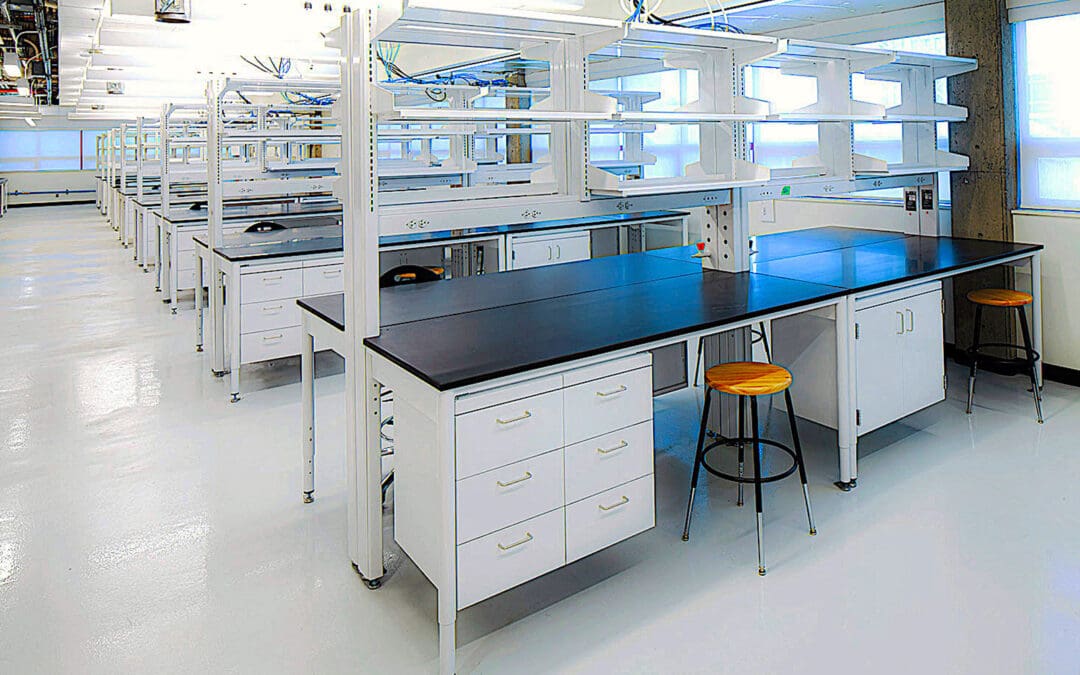
The Symphony 2 Table System is a clear example of this approach. Each table frame module is height adjustable, stand alone, and fully self contained. Mechanical and electrical services are factory installed, pre plumbed, and pre wired, with top connectors that plug directly into Symphony II Service Ceiling Panels. This plug and play configuration allows the entire assembly to be relocated with its fixtures intact, significantly reducing the need for on site trades during a move.
Because the system can convert from a single sided wall configuration to a double sided island assembly, laboratories can adapt layouts in a new facility without purchasing entirely new furniture. Distribution centres are removable and relocatable, giving planners greater control when reconfiguring bench arrangements.
For organizations anticipating growth or phased facility development, this level of flexibility provides long term value well beyond the initial installation.
Modular Cantilever Systems for Evolving Lab Layouts
The Allegro Cantilever System supports laboratory relocation by allowing work surfaces, shelving, and suspended cabinets to be adjusted or repositioned quickly. Height adjustments can be completed in minutes. Cabinets can slide laterally along rails or be removed entirely.
Rear service chases provide accessible routing for plumbing and electrical connections, simplifying disconnection and reconnection during a move. When combined with mobile tables or Crescendo carts, the system creates adaptable work zones that can be staged, relocated, and reassembled without compromising infrastructure.
For facilities planning a phased relocation, this type of modular laboratory casework allows departments to transition in stages while maintaining operational continuity.
Utility Tables That Move With You
Utility tables play an important supporting role in laboratory relocation. Built with robust powder coated steel or stainless steel frames and available with phenolic or epoxy resin work surfaces, these tables are designed to handle high loads and chemical exposure.
When specified with heavy duty locking casters, they become mobile assets rather than fixed furniture. Integrated shelving, drawers, and power strip kits further enhance their flexibility. In a relocation scenario, these tables can be redeployed immediately in temporary swing spaces or new lab configurations without modification.
Because they complement larger casework systems, utility tables often serve as the bridge between permanent infrastructure and short term adaptability.
Ceiling Service Panels and Overhead Carriers Simplify Transitions
One of the most significant barriers to efficient laboratory relocation is mechanical and electrical coordination. Traditional hard ducted systems require careful disassembly and reconnection by multiple trades.
Ceiling Service Panels and Overhead Service Carriers simplify this process. Designed to integrate directly with adaptable table systems, they allow services to connect and disconnect quickly. Laboratories can reconfigure bench positions beneath overhead carriers without modifying core building systems.
For organizations relocating within the same building or transitioning to a new facility with similar ceiling infrastructure, this approach minimizes downtime and reduces installation complexity.
Planning the Move Before It Happens
Successful laboratory relocation begins long before equipment is packed. Early planning should address space programming, service capacity, workflow mapping, and compliance requirements. Modular casework supports these conversations because it provides real flexibility in how space is ultimately used.
Working with a laboratory planning and design partner ensures that future relocation scenarios are considered during initial specification. With more than fifty years of experience in laboratory construction, Alliance Scientific collaborates directly with architects, designers, planners, and construction managers to create functional, efficient environments that support both current operations and future change.
In Design Build environments, early budgeting and integrated engineering resources further reduce uncertainty. By combining planning, engineering, and installation into a single coordinated process, organizations gain cost clarity and reduce the risk of delays during relocation.
Installation Expertise Makes the Difference
Even the most adaptable laboratory furniture system requires experienced installation teams. Engaging qualified installers early in the process ensures that casework is assembled, leveled, and connected properly from the start, which makes future relocation far simpler.
Strong coordination between planning teams and installation partners allows logistics to be mapped out in advance, minimizing disruption when the time comes to move. When modular casework is installed correctly, disassembly and reassembly become controlled processes rather than reactive problem solving.
Building Laboratories Designed for Change
Relocating your lab does not have to mean rebuilding from scratch. By investing in modular casework, adaptable table systems, and integrated service solutions, organizations create laboratory environments that are designed to move, evolve, and expand.
For institutions planning new facilities or anticipating future growth, specifying flexible laboratory furniture from the outset is a strategic decision. It protects capital investment, reduces operational disruption, and supports long term research and educational goals.
A seamless laboratory relocation is not the result of last minute logistics. It is the outcome of thoughtful planning, adaptable infrastructure, and experienced partners who understand how laboratories function both today and tomorrow.