
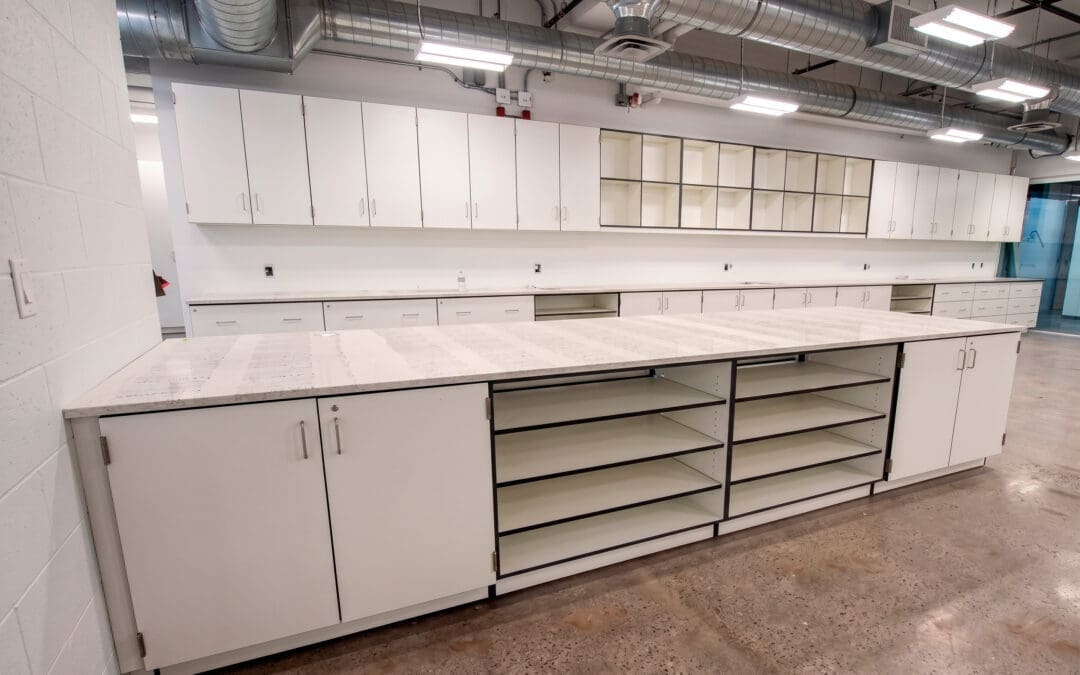
Selecting the right laboratory countertop is one of the most important decisions in any lab design or renovation project. Work surfaces are exposed daily to chemicals, moisture, heat, and heavy equipment, meaning material choice has a direct impact on safety, performance, and long-term durability.
Among the most commonly specified materials in modern laboratory environments is phenolic resin. Known for its balance of chemical resistance, moisture tolerance, and design flexibility, phenolic countertops have become a practical solution across a wide range of scientific and educational facilities.
Understanding where phenolic resin work surfaces perform best can help architects, planners, and facility managers make informed decisions when specifying laboratory casework systems.
What Are Phenolic Countertops?
Phenolic resin countertops are engineered work surfaces made by compressing layers of resin-saturated kraft paper under high heat and pressure. This manufacturing process creates a dense, solid-core material that is non-porous and highly resistant to moisture.
The result is a durable surface that performs well in environments where cleanliness, chemical exposure, and frequent washing are standard operating conditions.
Phenolic resin is often specified as part of complete laboratory casework systems, particularly in environments where consistent performance and low maintenance are priorities.
Why Laboratories Choose Phenolic Resin Work Surfaces
Phenolic countertops are widely used in laboratory settings because they offer a practical balance of performance characteristics. While no single material is suitable for every application, phenolic resin performs reliably in many common laboratory environments.
One of its key advantages is moisture resistance. Because the material is non-porous, it does not absorb liquids, which makes it well suited for wet lab areas, wash stations, and environments with frequent cleaning protocols.
Phenolic resin also offers good chemical resistance against many commonly used laboratory reagents. This makes it suitable for general research environments, pharmaceutical settings, and educational science labs where moderate chemical exposure is expected.
In addition to performance, phenolic countertops are available in a range of thicknesses, typically 1 inch or 3/4 inch, and are commonly supplied in black as a standard finish, with additional colour options available depending on project requirements.
Ideal Applications for Phenolic Countertops
Phenolic resin countertops are frequently specified in laboratories where durability and moisture resistance are key considerations but where extreme chemical resistance is not always required.
These include clinical and diagnostic laboratories, where cleanliness and frequent surface sanitization are essential. They are also commonly used in educational environments such as high school and university science labs, where durability and ease of maintenance are important due to high student usage.
Pharmaceutical and biotechnology laboratories often incorporate phenolic resin work surfaces in support areas or general preparation zones, while analytical testing facilities may use them for standard lab procedures that do not involve highly aggressive chemicals.
Phenolic countertops are also a strong choice for areas around sinks, wash stations, and spill-prone zones where moisture exposure is more frequent than chemical exposure.
Design Flexibility and Practical Features
Beyond performance, phenolic resin countertops offer flexibility in laboratory design. They can be fabricated into custom sizes and configurations to accommodate different casework layouts and equipment requirements.
Marine edge profiles are also available for applications where spill containment is important, helping prevent liquids from running off the work surface.
Phenolic resin can be paired with compatible laboratory casework systems, allowing for integrated storage, support framing, and service access within a complete lab design.
Epoxy resin sinks are also commonly integrated into phenolic work surface systems, supporting a wide range of laboratory applications that require built-in wash capabilities.
Phenolic Countertops in Modern Laboratory Design
As laboratories continue to evolve, material selection plays an increasingly important role in both functionality and lifecycle planning. Phenolic resin remains a widely specified option because it performs consistently in environments where moisture exposure, cleaning protocols, and moderate chemical use are part of daily operations.
When specified as part of a coordinated laboratory design, phenolic countertops contribute to efficient workflows, simplified maintenance, and long-term durability.
For many institutions, the decision is not simply about choosing a countertop material, but about selecting a system that integrates with broader laboratory infrastructure, including casework, ventilation, and adaptable workspace design.
Final Thoughts
Phenolic countertops continue to be a reliable and widely used solution in laboratory environments across education, healthcare, research, and industrial sectors. Their combination of moisture resistance, chemical tolerance, and design flexibility makes them a practical choice for many standard laboratory applications.
If phenolic is looking like the right fit, our phenolic resin laboratory countertops page covers technical performance, applications and the customization options available.