
A teaching laboratory has different demands than a research or industrial lab. Students are learning procedures, instructors need clear sightlines, and multiple people may be working with laboratory chemicals at the same time. That makes ventilation an important part of teaching laboratory design.
The right ventilation system should support laboratory safety while allowing students and instructors to work comfortably and maintain visibility throughout the room.
Why Ventilation Matters in a Teaching Laboratory
Teaching laboratories are often designed for group instruction, which means several students may be conducting experiments simultaneously. Fume hoods and other ventilation systems must be positioned and configured to support these activities without creating unnecessary barriers between students and instructors.
Good laboratory planning considers airflow, hood placement, room layout and the type of work taking place. Ventilation also has to work alongside other systems, including laboratory casework, work surfaces and utility services.
Balancing Airflow and Visibility
In a teaching environment, a fume hood has to do more than provide ventilation. It also needs to support the way instructors demonstrate procedures and students observe experiments.
Clear sightlines can make it easier for instructors to monitor work and for students to follow demonstrations. This is one reason visibility is an important consideration when selecting a fume hood for a teaching laboratory. The hood should provide the required containment and airflow while fitting naturally into an instructional environment.
Why Vision Teaching Hoods Are Designed for Instruction
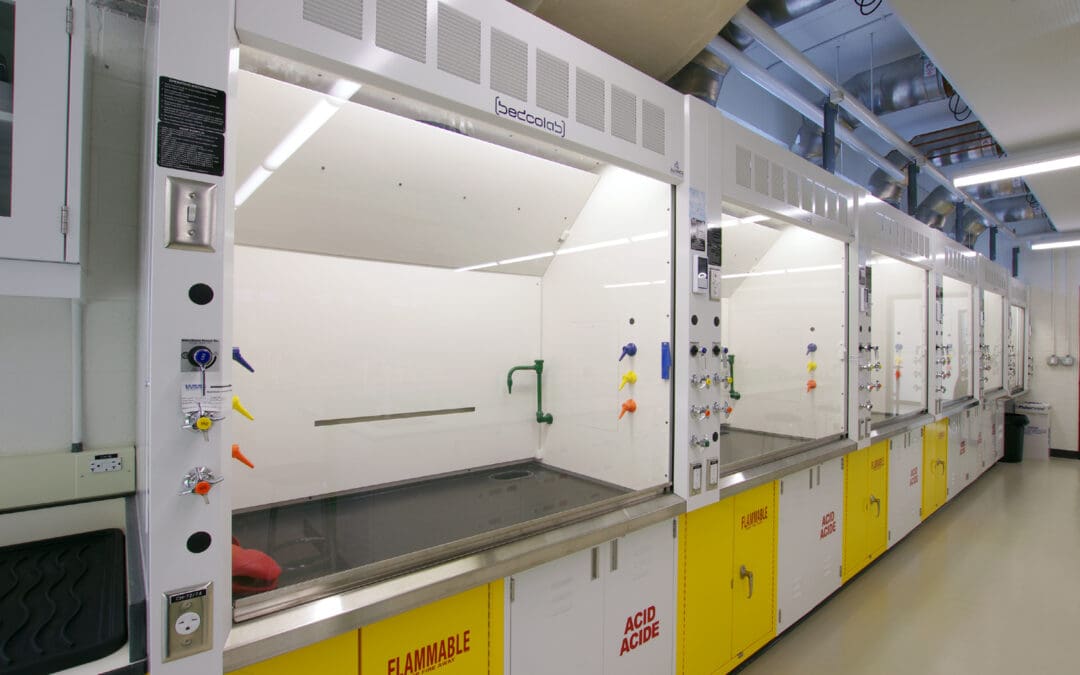
A Vision Teaching Hood is specifically designed for educational environments where visibility is a priority. Glass side panels and backs provide a clearer view of demonstrations and experiments, allowing instructors to maintain visual contact with students while work is taking place inside the hood.
The visibility comes from how the hood is built rather than from a larger opening. Interior glass side panels and glass backs create multiple sight lines through the hood, and vertical rising sashes keep the working opening clear during a demonstration. An integrated rear lower and side post baffle arrangement manages airflow inside that glazed enclosure, so containment is maintained without closing the view down.
Vision Teaching Hoods can be configured for side-by-side or back-to-back installations, making them adaptable to different teaching laboratory layouts. They can also be designed with constant air volume (CAV) or variable air volume (VAV) ventilation, depending on the requirements of the facility.
For universities, colleges and other educational facilities, this combination of ventilation, visibility and flexible configuration can make a significant difference in how effectively a teaching laboratory functions.
Side-by-Side or Back-to-Back: What the Layout Changes
Vision Teaching Hoods are built for single-sided side-by-side arrangements and for back-to-back configurations. The choice usually has more to do with the room than with the hood itself.
A side-by-side run along a wall gives every student the same orientation and keeps the instructor in one position during a demonstration. It also consumes perimeter wall space, which has to be balanced against casework, sinks and service runs competing for the same walls.
Back-to-back pairs place hoods within the body of the room, often as an island, which frees the perimeter and can shorten the distance between a student workstation and a hood. It also changes where exhaust ductwork and services have to land. That is why the arrangement belongs in the early design conversation rather than at the procurement stage, when the mechanical routing is already fixed.
CAV or VAV in a Teaching Laboratory
Vision Teaching Hoods are designed for both constant air volume and variable air volume systems. In a teaching laboratory, the decision is shaped less by any single hood than by how many hoods share the room and how the room is actually used.
A teaching lab may run several hoods at once during a scheduled session, then sit largely idle between classes. That pattern is where the ability of a VAV system to modulate exhaust with sash position becomes relevant, though it also depends on sashes being lowered consistently, which is a training and signage question as much as an engineering one. The simplicity of a CAV system remains attractive where the ventilation load is steady and predictable.
The full comparison is covered in our guide to CAV versus VAV fume hoods. For a teaching space, the short version is that the decision should be made with the room schedule and the hood count in view, not hood by hood.
Accessibility Belongs in the Early Layout
A teaching laboratory has to work for every student in the class. Across the fume hood range we supply, hoods are available in accessible configurations alongside bench mount, floor mount and pass-through (double-sided) designs, with liner materials and aerodynamic performance built to standards such as ASHRAE 110.
Those configurations affect bench height, knee clearance and the reach to the sash and to services. Specifying at least one accessible hood position early is far easier than retrofitting one later, because the surrounding casework and utility connections have to suit it.
Planning Ventilation Into the Lab Design
Ventilation should be considered early in the design process rather than treated as a standalone component. The location of fume hoods, airflow requirements, utilities, casework and student workstations all influence how the finished laboratory will perform.
At Alliance Scientific, we support laboratory planning with solutions that bring ventilation, furniture and equipment together as part of a coordinated design. Our team works with educational institutions, architects, designers and construction professionals to develop laboratory environments suited to the way they will actually be used.