
If you’ve ever researched laboratory casework, countertops, or chemical fume hoods, you’ve probably seen the phrase “chemical resistant” used over and over again.
But what does it actually mean?
Many people assume that if a product is labelled chemical resistant, it can withstand any chemical indefinitely. In reality, chemical resistance is much more nuanced. Different laboratory materials are designed to withstand different types of chemicals, varying levels of exposure, and different cleaning protocols.
Understanding what chemical resistance really means can help architects, consultants, facility managers, and laboratory owners choose materials that perform reliably for years, rather than replacing damaged surfaces prematurely.
Chemical Resistance Doesn’t Mean Chemical Proof
One of the biggest misconceptions is that chemical resistant means indestructible.
No laboratory material is designed to be unaffected by every chemical under every condition. Instead, chemical resistance refers to a material’s ability to withstand exposure to specific chemicals for a given period of time without significant damage.
Performance can vary depending on factors such as:
- the type of chemical
- its concentration
- exposure time
- temperature
- whether spills are cleaned promptly
This is why selecting laboratory furniture and work surfaces should always begin with understanding how the laboratory will actually be used.
Why Chemical Resistance Matters
Laboratories are exposed to substances that would quickly damage conventional furniture.
Acids, bases, solvents, disinfectants, and cleaning agents are all part of everyday laboratory operations. If cabinetry or work surfaces cannot withstand repeated exposure, they may begin to stain, swell, corrode, crack, or deteriorate over time.
Choosing materials designed for laboratory environments helps protect both the laboratory itself and the investment made in the facility.
This is one of the reasons laboratory-grade furniture differs significantly from commercial cabinetry, even when the two may appear similar at first glance.
It’s Not Just the Material That Matters
One point that’s often overlooked is that chemical resistance isn’t determined solely by the base material.
For example, metal laboratory casework achieves its laboratory performance through a durable chemical-resistant powder-coated finish applied to the welded steel cabinet. Likewise, wood laboratory casework intended for laboratory use is manufactured with specialized coatings that protect the surface from moisture, routine cleaning, and chemical exposure.
Without these protective finishes, neither material would be suitable for many laboratory applications.
This is why laboratory casework should always be specified as a complete system rather than simply selecting a material.
Different Materials Offer Different Levels of Protection
Not every laboratory requires the same level of chemical resistance. The appropriate material depends on the environment, the chemicals being used, and the cleaning protocols within the facility.
Phenolic Resin
Phenolic resin work surfaces are an excellent choice for laboratories where moderate chemical exposure and frequent cleaning are expected.
Their non-porous construction makes them well suited for educational laboratories, pharmaceutical facilities, clinical spaces, and wet lab applications where moisture resistance is important.
Epoxy Resin
When laboratories work with highly aggressive chemicals or require exceptional heat and impact resistance, epoxy resin is often the preferred solution.
Because epoxy resin is a solid, monolithic material, its chemical resistance extends throughout the entire work surface rather than relying on a surface coating. This makes it ideal for demanding research environments where durability is critical.
Stainless Steel
Some laboratory environments place less emphasis on chemical exposure and more on hygiene and contamination control.
Stainless steel surfaces are commonly specified for pharmaceutical facilities, healthcare laboratories, food testing environments, and other applications requiring frequent washdowns and rigorous cleaning protocols.
Its smooth, non-porous surface makes it easy to sanitize while providing excellent resistance to moisture and corrosion.
Chemical Resistance Extends Beyond Cabinets
Chemical resistance isn’t limited to laboratory casework and countertops.
Laboratory sinks, fixtures, storage cabinets, adaptable furniture systems, and chemical fume hoods all play a role in creating a safe laboratory environment.
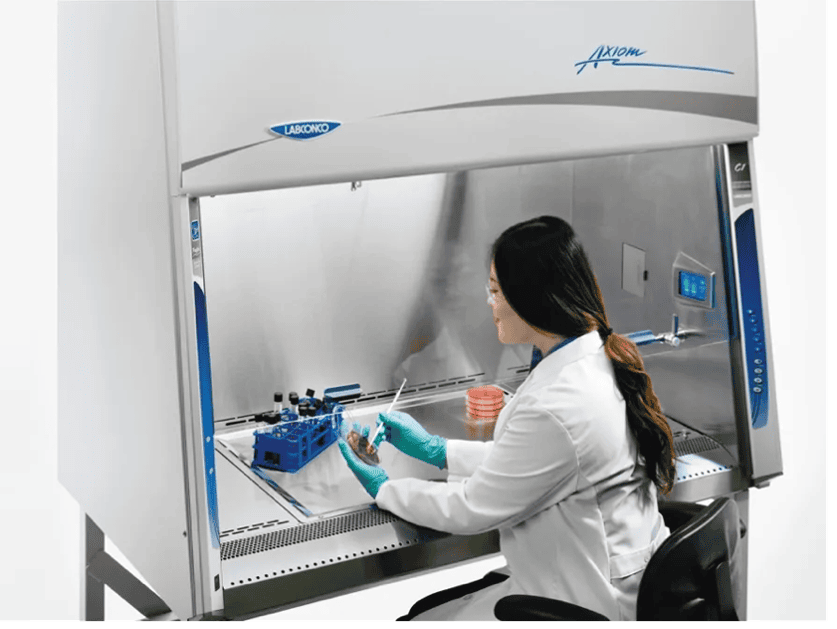
Chemical fume hoods, for example, are constructed using materials selected to withstand repeated exposure to corrosive vapours while safely containing and exhausting hazardous fumes. Likewise, sinks and fixtures are chosen based on the chemicals and processes taking place within the laboratory.
Selecting compatible materials across the entire laboratory helps ensure consistent performance throughout the facility.
Chemical Resistance Is Only One Part of Laboratory Performance
Although chemical resistance is an important consideration, it should never be evaluated in isolation.
The best laboratory designs balance chemical resistance with durability, cleanability, structural performance, workflow, flexibility, and compliance with recognized industry standards such as SEFA.
Choosing materials based solely on chemical resistance can result in overspecifying certain areas or overlooking other important performance requirements.
The goal is to select materials that are appropriate for each space rather than assuming one solution fits every laboratory.
Final Thoughts
Chemical resistance is one of the defining characteristics of laboratory-grade furniture, but it isn’t simply a marketing term. It reflects how materials, finishes, and construction methods work together to withstand the demanding conditions found in modern laboratories.
Whether you’re specifying laboratory casework, work surfaces, or chemical fume hoods, understanding how different materials perform under chemical exposure helps ensure the finished laboratory is safe, durable, and built for long-term success.